Open Doors at The Potter's House
Room To Care joined VisioTech at The Potter's House in Dallas for an honest conversation about what it actually takes to keep children safe in an always-online world.

Scott Burch
Founder & Executive Director
Some friendships start with something small. For Tiffani Martin and me, it was a high school United Nations Debate Team.
We weren't the students anyone would have grouped together by design. We both occupied that particular space in high school where you feel like you're orbiting somewhere slightly outside the main circle. We had classes together, enough history to say we knew each other, but it was our History and Government teacher who pushed us toward each other by suggesting we channel our opinions somewhere useful. Join debate, he told us. If you're going to argue, at least do it intelligently.
That was the beginning of a friendship that has lasted well past graduation, through diverging careers and enough projects, conversations, and strategy sessions to fill its own book.
Tiffani went on to build something remarkable. After losing her sight at 28 due to diabetic retinopathy, she founded VisioTech, a women-owned social impact technology company built on a straightforward belief: technology should work for everyone. VisioTech develops accessible AI solutions, co-created the Accessible AI Quotient (AAIQ) framework, and has earned Tiffani recognition as a Dallas Business Journal 40 Under 40 honoree and a Black Enterprise 40 Under 40 honoree. She earned her MBA from Baylor University's Hankamer School of Business and has spent years at the intersection of AI governance, accessibility, and inclusion. Connect with VisioTech on LinkedIn.
We have a running bet on who gets to the cover of Forbes first. I'd be happy to lose that one.
When Tiffani invited Room To Care to join VisioTech's STIL 26 program and present at The Potter's House in Dallas, I said yes before she finished the sentence.

What we brought to the room
The Potter's House gave us their volunteers. A room full of people who already give their time to others, who already care. That made the conversation different from the start.
The session ran under our Open Doors framework: family-centered education about digital exploitation, online grooming, and the ways AI has changed what children are actually up against. Room To Care's first program is Through Their Eyes, focused on human trafficking awareness. Open Doors is what we're building for families, teachers, young teens, and college students. April 19th was the first time we brought it to a live audience at this scale, and The Potter's House was the right room for it.
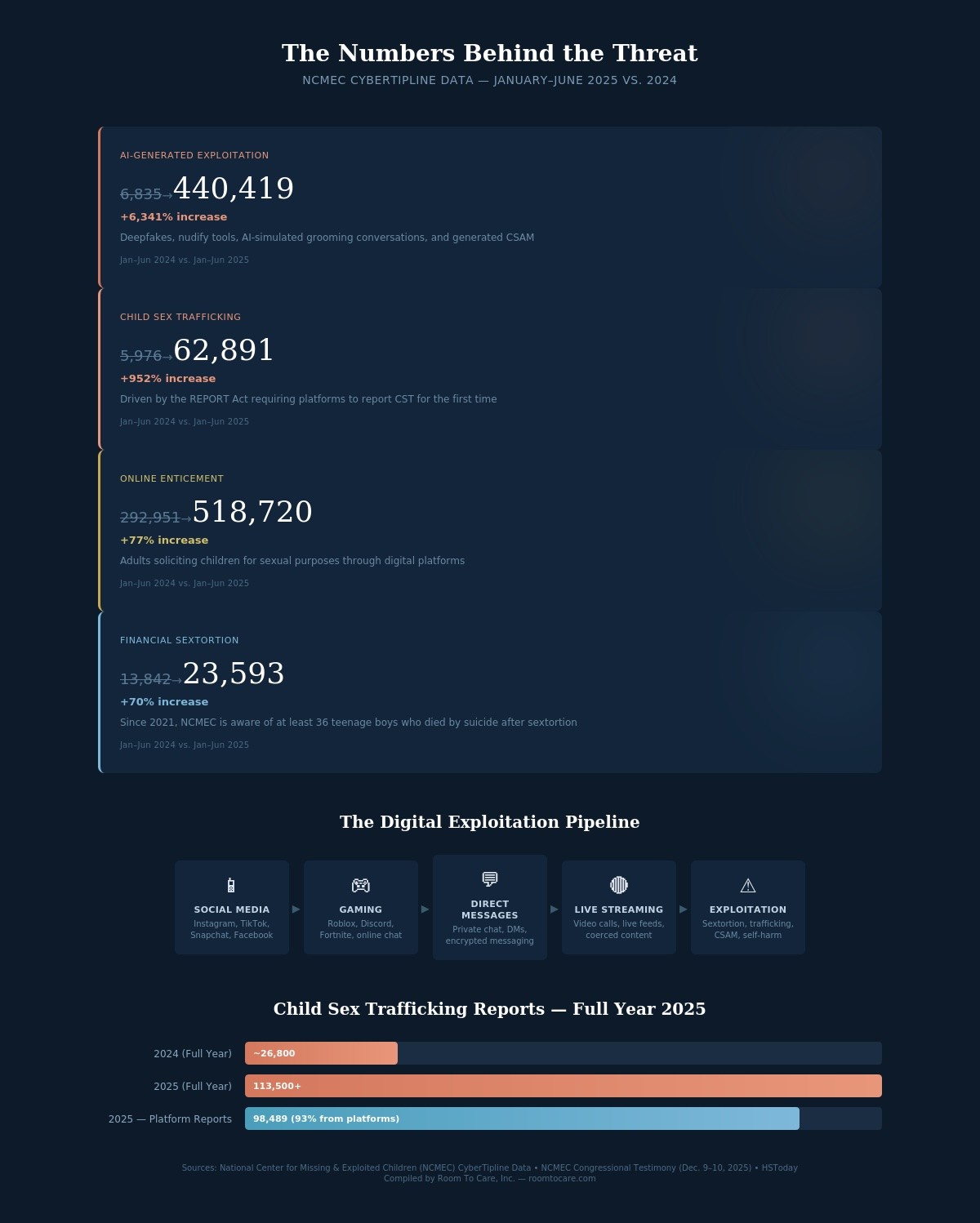
We covered the landscape honestly. Generative AI exploitation reports to NCMEC reached 440,419 in just the first half of 2025, up from 6,835 in the same period the year before. Online enticement reports hit 518,720 in that same window, a 77 percent increase year over year. Since 2021, NCMEC is aware of at least 36 teenage boys who took their own lives because of sextortion. These are not abstract numbers.
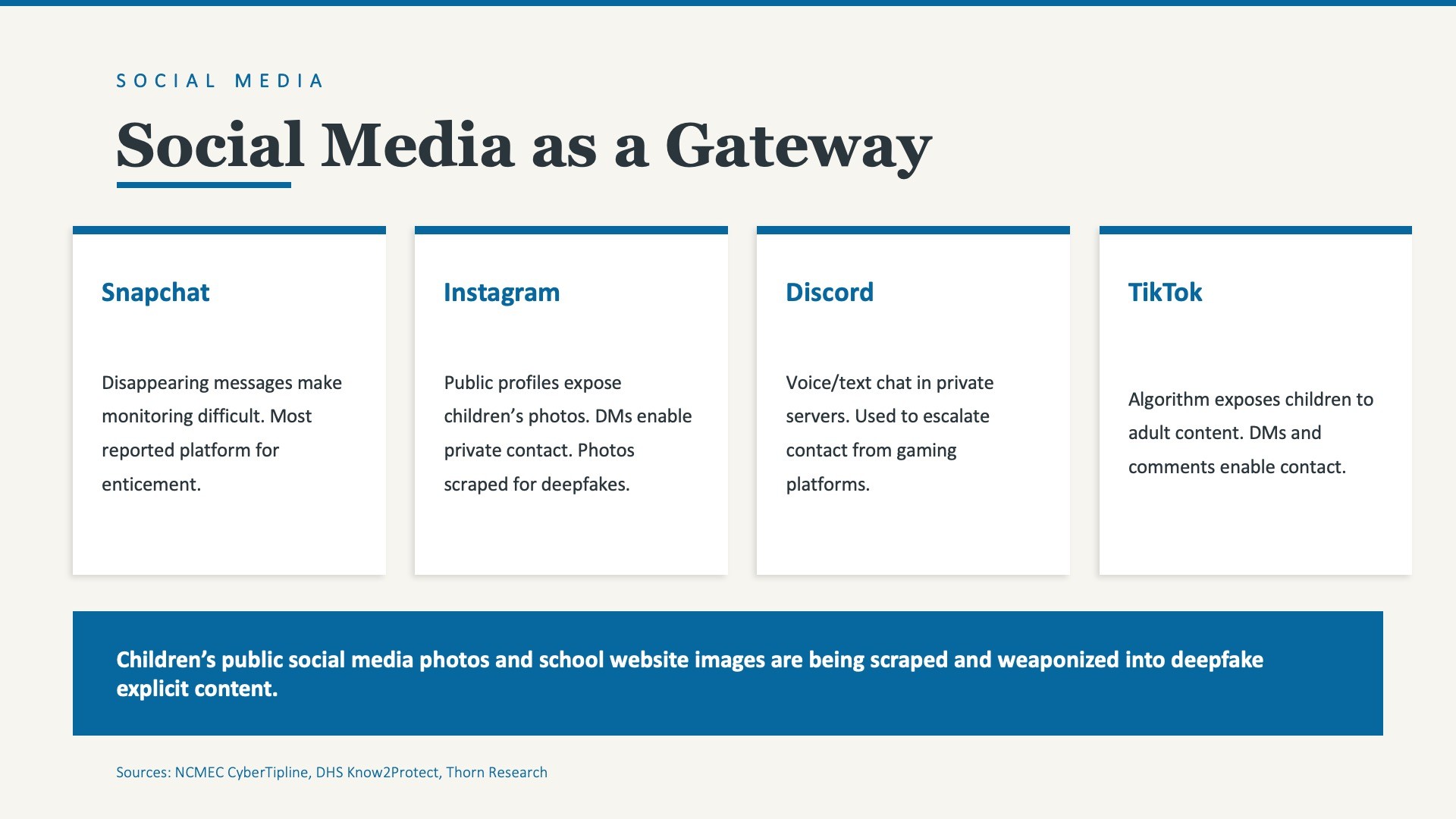
We talked about how predators operate inside gaming platforms. They pose as same-age kids, use voice changers to sound younger, offer in-game gifts to build trust, then move the conversation to Discord or Snapchat before anyone notices. They capture facial images and use AI to generate deepfakes. The whole sequence can happen over weeks, invisibly, inside games parents see as safe.
Tiffani brought the AI literacy piece in a way that landed differently than a statistics slide could. She knows this technology and lives inside it professionally. Watching her walk a room full of volunteers through what generative AI actually does, and how it's being weaponized, gave the conversation a credibility that doesn't come from slides alone.
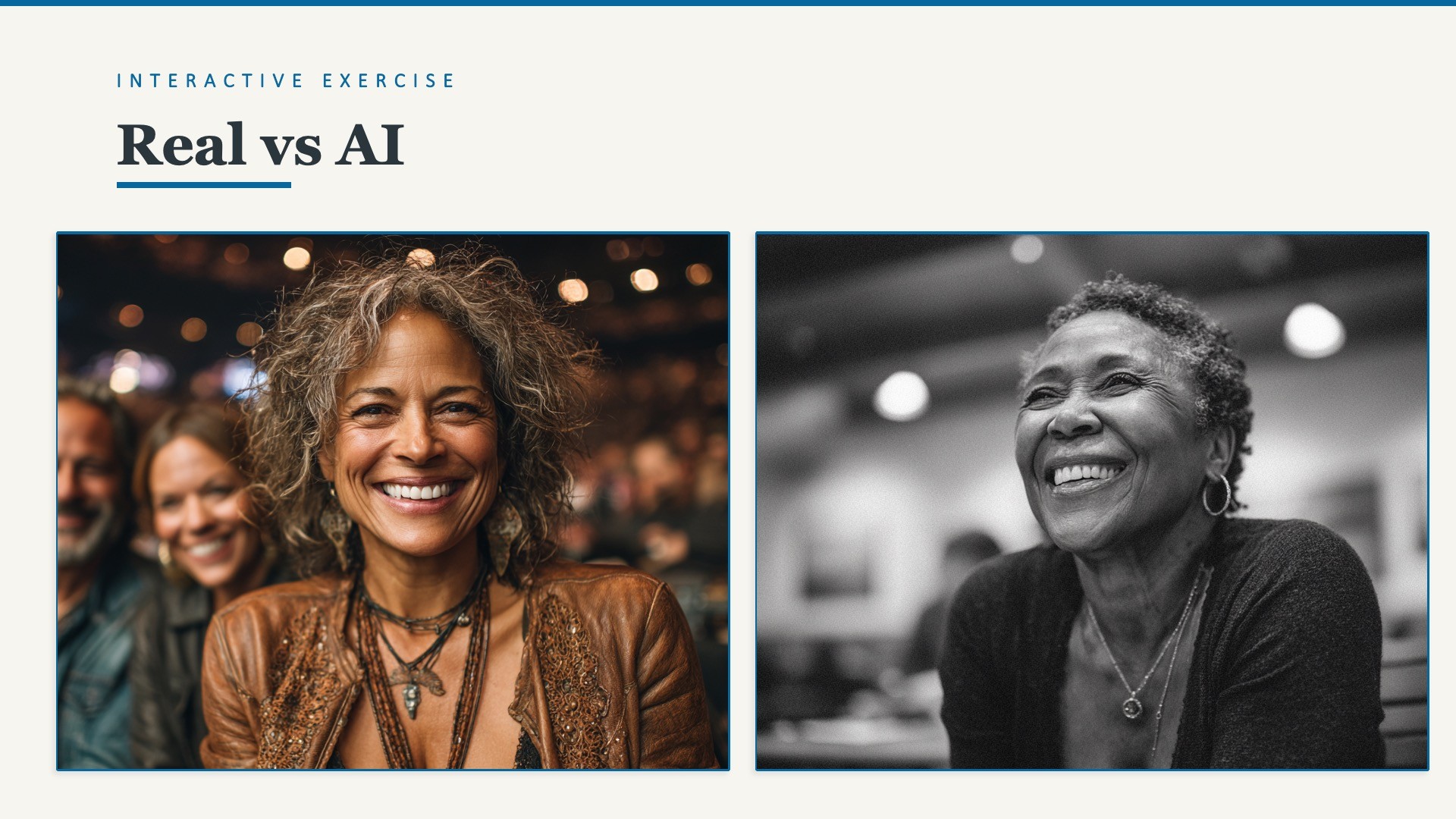
Can you spot the fake?
We ran the audience through an interactive exercise adapted from NCMEC: a series of images and short video clips, some real, some AI-generated. The room was surprised by how difficult the test was. That was the point. If adults trained to pay attention struggle to tell the difference, children are not going to catch it on their own.
The main message
No parental control app covers this. Platform filters, screen time limits, and monitoring tools are worth having, but they are not a strategy. The research is consistent: children who can talk openly with a trusted adult about their online experiences are significantly less likely to be successfully exploited. Not children with the best filter. Children with the most open relationship.
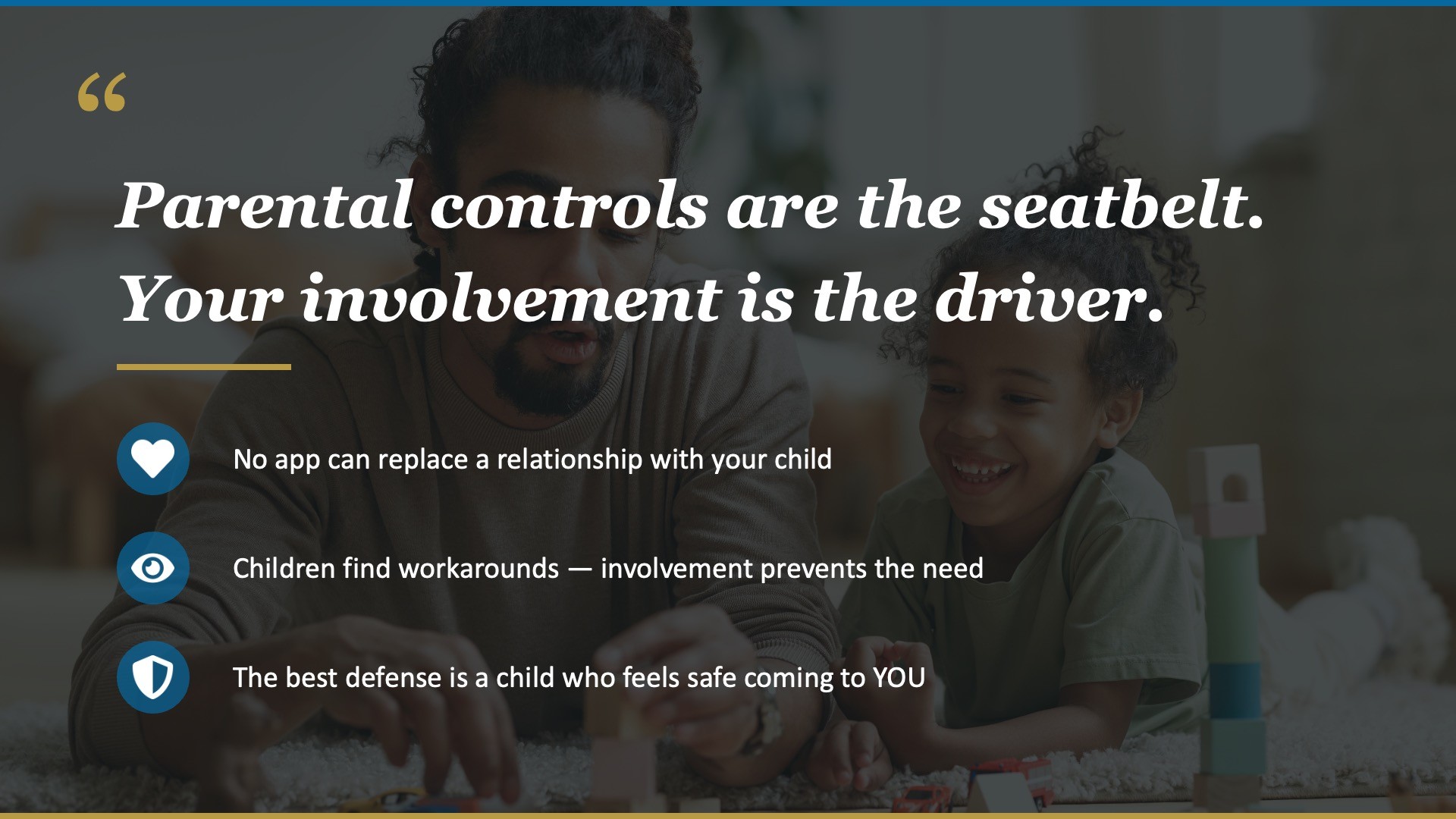
That means knowing what your kids are doing online and who they talk to. Sharing with them, honestly and without turning it into a lecture, what is actually out there. Not judging them when they tell you something uncomfortable. Being the kind of parent or guardian they come to, not the kind they hide things from.
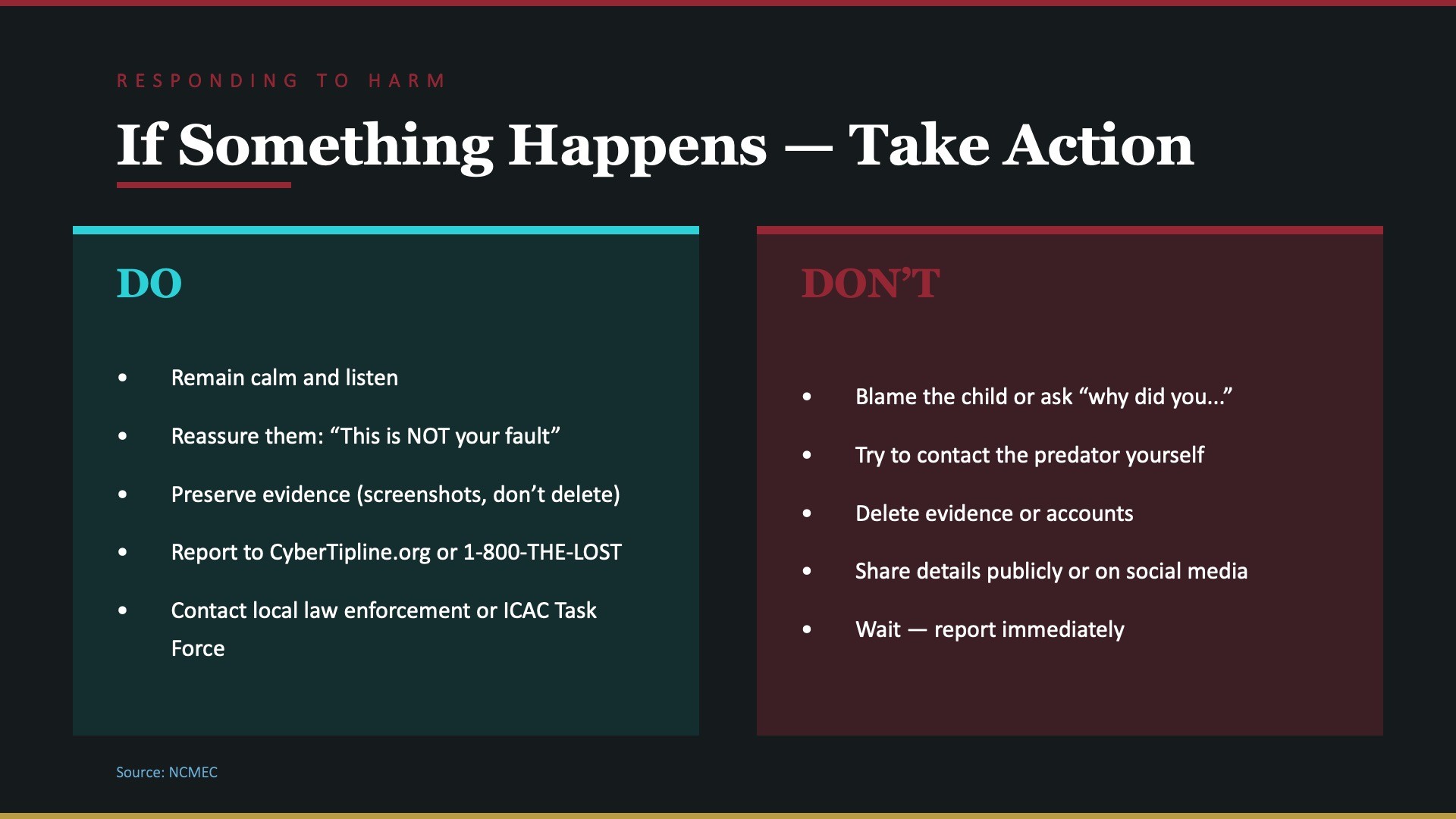
If a child does get caught up in something, shame and silence are what exploitation depends on. The door stays open when the adult in the room keeps it open.
Gratitude
We are grateful to The Potter's House for opening their doors and trusting us with their volunteers. The Potter's House has long been a place where hard conversations get taken seriously in Dallas, and that showed in the room on April 19th.
And to Tiffani: thank you for two decades of friendship and for building the kind of company that takes technology's real-world consequences seriously. VisioTech and Room To Care don't do the same work, but we share the same conviction that technology and education should serve the people most likely to be left behind by both.
Learn more about Tiffani and VisioTech at visiotech.co and connect on LinkedIn.
Room To Care is developing Open Doors for broader deployment. If you represent a school, congregation, youth organization, or community group and want to bring this program to your community, reach out at info@roomtocare.com.
Support this work at roomtocare.com/donate.
Read more

Behind the Stories: A Week of Filming
Room To Care spent this week in Frisco with survivors, cameras rolling and hours of footage captured. Here's where things stand and what comes next.
Scott Burch
Founder & Executive Director

Through Their Eyes Production Update: Filming Starts Next Week
Our first survivor interviews for Through Their Eyes begin April 28th. Here's what that means, what you'll see, and what we still need.
Scott Burch
Founder & Executive Director
Open Doors at The Potter's House
Room To Care joined VisioTech at The Potter's House in Dallas for an honest conversation about what it actually takes to keep children safe in an always-online world.
Scott Burch
Founder & Executive Director