When the Safety Net Disappears
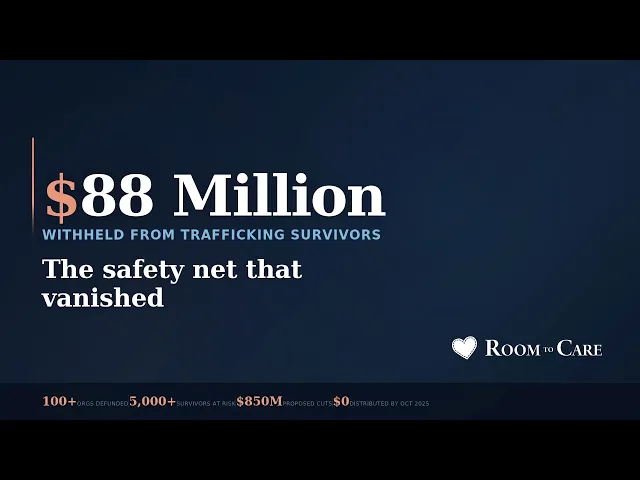
Congress set aside $88 million to help trafficking survivors. The Department of Justice chose not to spend it. Over 100 organizations lost funding. More than 5,000 survivors were left without services. And this is happening while the same government passes new laws requiring anti-trafficking training. This is not a policy disagreement. This is a contradiction that is costing people their safety.
4 months ago

Scott Burch
Founder & Executive Director
When the Safety Net Disappears
Congress set aside $88 million to help trafficking survivors. The Department of Justice chose not to spend it. Over 100 organizations lost funding. More than 5,000 survivors were left without services. And this is happening while the same government passes new laws requiring anti-trafficking training.
This is not a policy disagreement. This is a contradiction that is costing people their safety.
What Happened
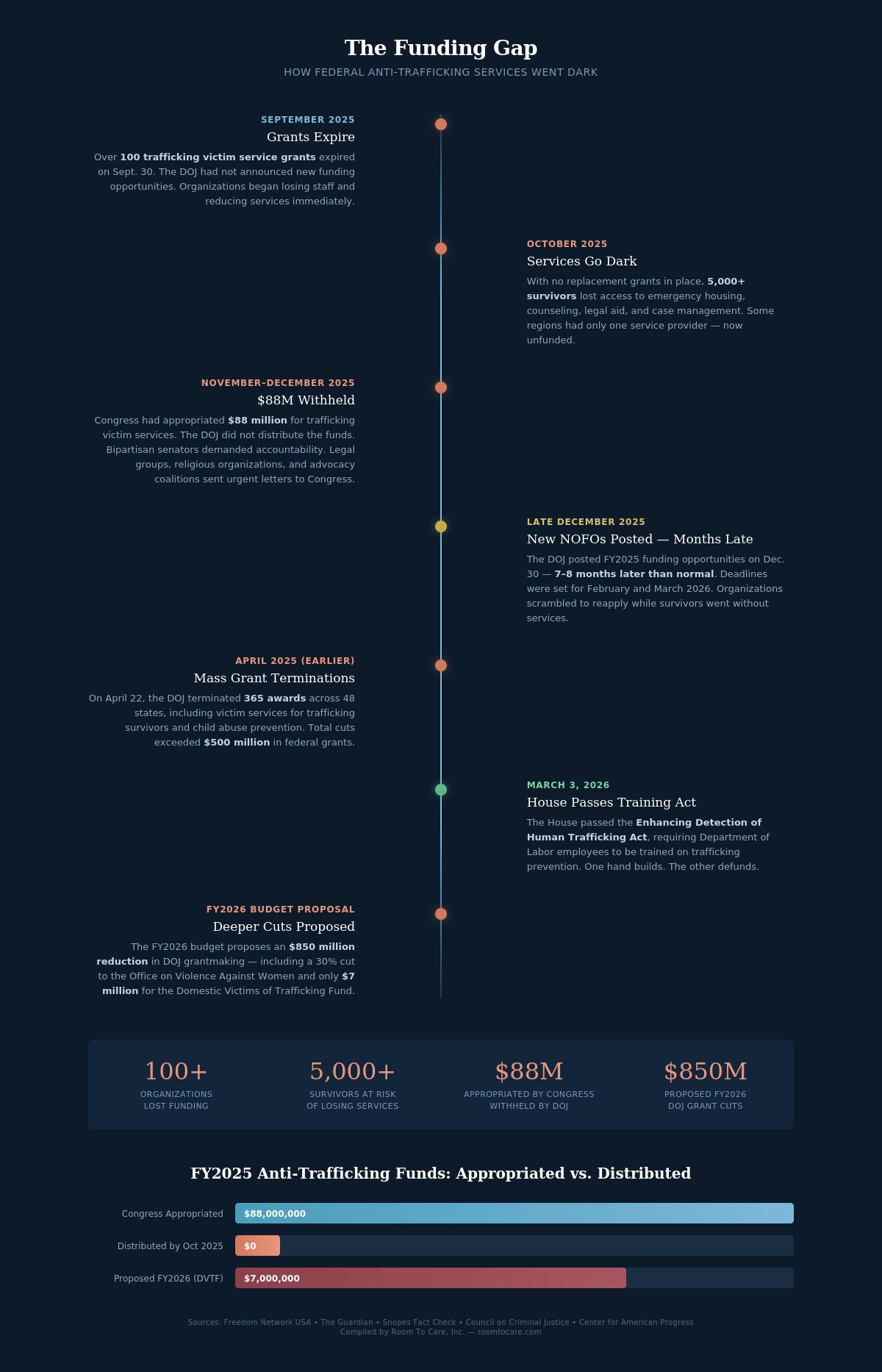
On September 30, 2025, federal funding for more than 100 organizations providing direct services to trafficking survivors expired. This was not a surprise. These grants operate on known cycles. What was different this time is that the Department of Justice had not announced new funding opportunities to replace them.
This is not how the system typically works. In recent years, the DOJ has announced new anti-trafficking grant competitions in March or April, well before the previous cycle's funding runs out. In 2025, that did not happen. Not in March. Not in April. Not in May. Not through the summer. The grants expired, and nothing replaced them.
By October, organizations that had been serving survivors for years were suddenly operating without federal support. Staff were laid off. Programs were suspended. Survivors who depended on these services, for housing, for legal representation, for safety, were told there was nowhere to go.
Freedom Network USA reported that at least 5,000 survivors were immediately at risk of losing access to lifesaving services. In many regions, there was only one trafficking-specific service provider. When that organization lost funding, the entire safety net for that area disappeared.
In December, bipartisan members of Congress publicly demanded answers. Senator Gary Peters, who sits on the appropriations subcommittee that funds the DOJ, called the withholding of already-approved funds illegal. Legal advocacy groups, religious organizations, and anti-trafficking coalitions sent letters to Congress warning of the consequences: survivors returning to unsafe situations, being re-exploited, or becoming homeless.
The DOJ finally posted new funding opportunities on December 30, 2025, seven to eight months later than the typical timeline. Application deadlines were set for February and March 2026. But even if organizations submitted applications immediately, it would take months for grants to be reviewed, approved, and disbursed. The gap between the end of old funding and the beginning of new funding left thousands of survivors without support during the most vulnerable months of the year.
This Was Not an Isolated Decision
The September expiration did not happen in a vacuum. It followed a pattern of funding reductions across the federal anti-trafficking and victim services landscape.
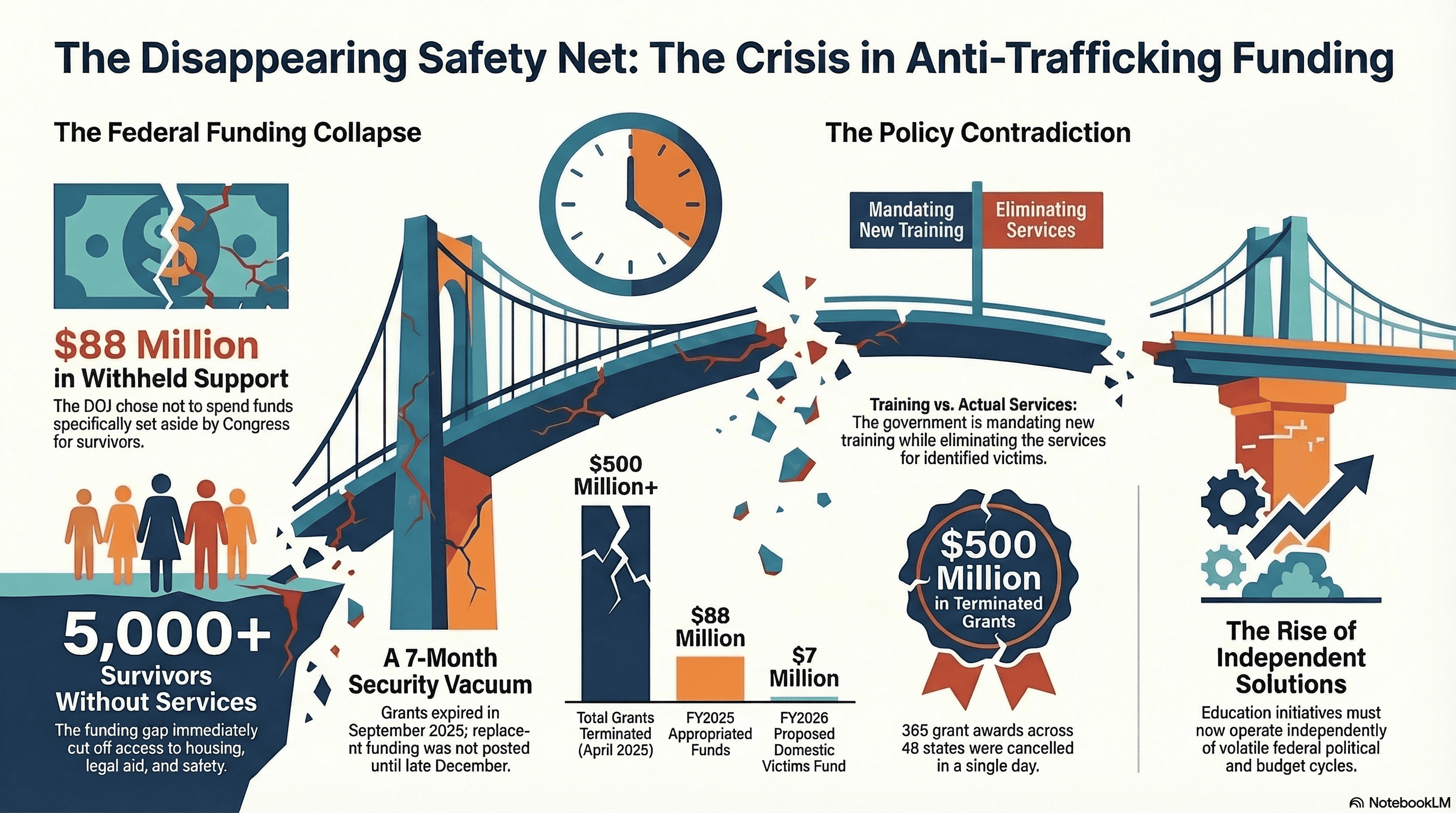
In April 2025, the DOJ terminated 365 grant awards across 48 states in a single day. The stated justification was that the work "no longer effectuates Department priorities." Among the terminated grants were direct funding for trafficking victim services, technical assistance for providers serving survivors with disabilities, and training for judicial personnel handling child abuse cases. The Council on Criminal Justice documented that the total value of these terminated awards exceeded $500 million.
The FY2026 budget proposal goes further. It calls for an $850 million reduction in DOJ grantmaking overall. The Office on Violence Against Women, which funds services for trafficking, domestic violence, and sexual assault survivors, faces a proposed 30% cut. The Domestic Victims of Trafficking Fund would receive just $7 million.
For context: Congress appropriated $88 million for trafficking victim services in FY2025 alone. The proposed FY2026 allocation of $7 million for the Domestic Victims of Trafficking Fund represents a fraction of what has historically been spent.

What It Means for Survivors
When trafficking-specific services disappear, survivors do not simply wait for them to return.
Some go back to the situations they escaped because there are no alternatives. Some end up homeless. Some face criminal charges related to their trafficking because legal advocacy was no longer available. Some are deported. Some are re-exploited.
This is what happens when a safety net is not just weakened but removed. The organizations providing these services are not theoretical. They are the people who answer the phone at 2 a.m. when a survivor needs a safe place to sleep. They are the case managers who help someone obtain identification documents so they can apply for a job. They are the legal advocates who ensure survivors are treated as victims in court, not as criminals.
When federal funding disappears, it does not just affect budgets. It affects whether a person who was trafficked can rebuild their life or gets pulled back into the cycle.
Jordann Hare, a trafficking survivor who spent three years in modern slavery, described the impact in direct terms. Without the services she received from a federally funded nonprofit, she said she would be in prison or dead. The message the government is sending to survivors, she said, is the same message they received from their traffickers: you do not matter.
The Contradiction
On March 3, 2026, the U.S. House of Representatives passed the Enhancing Detection of Human Trafficking Act. The bill requires the Department of Labor to train its employees on effectively assisting law enforcement in preventing human trafficking.
This is a good thing. Training is essential. Identification is critical. This is, in fact, exactly what Through Their Eyes is built to do: equip people across industries with the knowledge and awareness to recognize trafficking and respond appropriately.
But there is an undeniable tension in a government that passes new training requirements while simultaneously defunding the organizations that serve the people those trainings are designed to help identify. You cannot train someone to recognize a trafficking victim and then eliminate the services that victim needs when they are found.
Training without services is awareness without a safety net. It is a system that teaches people to see the problem and then offers no solution.
This is the contradiction at the center of the current moment: the federal government acknowledges that trafficking is a crisis serious enough to require new legislation. And at the same time, it is reducing the resources available to address that crisis at every other level.
Why This Matters for What We Are Building
Room To Care was not designed to replace government services. No single organization can. But we were designed to operate independently of political cycles. Our funding comes from individual donors, corporate sponsors, and private grants, not from the institutions whose priorities shift with each administration.
Through Their Eyes is being built with this reality in mind. Not because we anticipated this specific funding crisis, but because we understood from the beginning that education and prevention work cannot depend on a system that treats survivor services as discretionary spending.
The program is modular by design, covering healthcare, hospitality, transportation, education, law enforcement, and more, because trafficking does not limit itself to one sector, and training should not either. It is survivor-informed, because the people who understand how trafficking operates are the people who lived it. And it is being developed to be accessible beyond corporate training portals, because the communities that need this education the most are often the last to receive it.
The DOJ funding crisis does not change our timeline. But it does sharpen the urgency. When federal systems pull back, the organizations and programs that remain become more important. Not as replacements for government responsibility, but as proof that the work continues regardless.
What You Can Do
Donate directly. Every dollar supports the development of Through Their Eyes and Room To Care's mission of education, prevention, and survivor-centered advocacy.
roomtocare.com/donate | givebutter.com/RoomToCare2026 | Text "RTC2026" to 53-555
Connect us with survivors. We are actively seeking introductory conversations with survivors of labor trafficking, familial trafficking, and digital exploitation. If you or someone you know has experience in these areas and is open to a conversation, please reach out through roomtocare.com.
Make an introduction. If you know foundations, organizations, or individuals who fund anti-trafficking education and prevention, an introduction goes further than you might think.
Share this post. Awareness of the funding crisis is itself a form of advocacy. The more people understand what is happening, the more pressure builds for accountability.
Stay informed.
Room To Care: roomtocare.com | Through Their Eyes: throughtheireyes.co | Rebecca Bender Initiative: rebeccabender.org | New Friends New Life: newfriendsnewlife.org
Sources
Freedom Network USA. Statement on DOJ Cutting Off Funding for Services for 5,000 Survivors (October 1, 2025).
The Guardian. US Justice Department Halts Funding for Human-Trafficking Survivors (December 22, 2025).
Snopes. Explaining DOJ Funding Gap for Human Trafficking Survivor Organizations (January 6, 2026).
Brennan Center for Justice. Justice Department Slashes Essential Services for Crime Victims.
Council on Criminal Justice. DOJ Funding Update: A Deeper Look at the Cuts (May 2025).
Council on Criminal Justice. Unpacking the President's 2026 Budget.
Center for American Progress. Delivering Accountability: A Plan To Stop Crime in Our Communities (January 29, 2026).
U.S. House of Representatives. House Passes Key Human Trafficking Detection Legislation (March 3, 2026).
Read more

Behind the Stories: A Week of Filming
Room To Care spent this week in Frisco with survivors, cameras rolling and hours of footage captured. Here's where things stand and what comes next.
Scott Burch
Founder & Executive Director

Through Their Eyes Production Update: Filming Starts Next Week
Our first survivor interviews for Through Their Eyes begin April 28th. Here's what that means, what you'll see, and what we still need.
Scott Burch
Founder & Executive Director

Open Doors at The Potter's House
Room To Care joined VisioTech at The Potter's House in Dallas for an honest conversation about what it actually takes to keep children safe in an always-online world.
Scott Burch
Founder & Executive Director